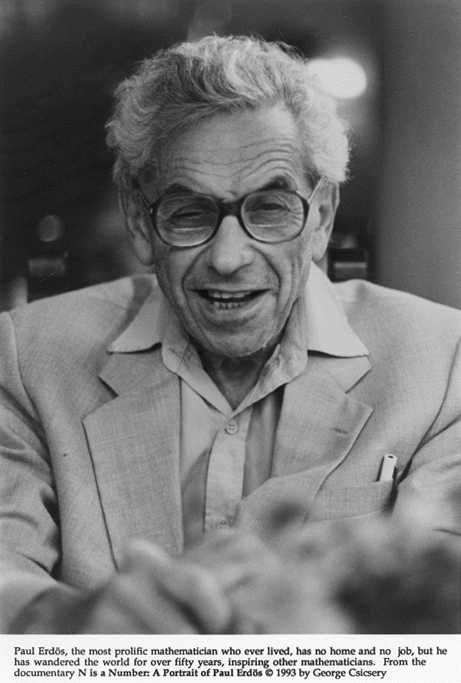
Erdös numbers have been a part of the folklore of mathematicians throughout the world for many years. For an introduction to our project, a description of what Erdös numbers are, what they can be used for, who cares, and so on, choose the “What’s It All About?” link below. To find out who Paul Erdös is, look at this biography at the MacTutor History of Mathematics Archive, or choose the “Information about Paul Erdös” link below.
WHAT’S INSIDE:
What’s It All About?: General overview, including our (admittedly arbitrary) rules for what counts as a research collaboration.
The Data: Lists of all of Paul Erdös’s coauthors and their respective coauthors, organized in various ways. There are also links to websites of or about Erdös’s coauthors.
Facts about Erdös Numbers and Collaboration: Statistical descriptions of Erdös number data, a file of the subgraph induced by Erdös’s coauthors, Erdös number record holders, facts about collaboration in mathematical research and the collaboration graph, including some information about publishing habits of mathematicians (for example, the median number of papers is 2, and the mean is about 7). This subpage has loads of information about the collaboration graph and Erdös numbers, including the distribution of Erdös numbers (they range up to 13, but the average is less than 5, and almost everyone with a finite Erdös number has a number less than 8) and “Erdös numbers of the second kind”.
Research on Collaboration: Papers on collaboration in scientific research, collaboration graphs and other small world graphs, and Erdös numbers. A lot of research is currently being done by various scientists on collaboration graphs and related topics.
Related Concepts: Six degrees of separation, the Kevin Bacon game, Small Worlds, academic genealogy, Hank Aaron, graph theory.
SPECIAL NOTES:
GEORGE SZEKERES, who wrote a paper with Paul Erdös in the first year Paul published joint work (1934), and his wife, ESTHER SZEKERES, who became an Erdös coauthor in 2002, died within an hour of each other on August 28. Click here or here for an obituary.
FRANK HARARY, the father of graph theory, died on January 4. Click here for an obituary.
The URL for this site has been simplified. Please update your links to it. The new URL is this:
http://www.oakland.edu/enp
MathSciNet now has the ability to find the collaboration distance between any two authors automatically. See the Compute Your Own Erdös Number subpage for details.
NOTES: The data shown on this site are based primarily on all items appearing in MathSciNetthrough the end of 2003. The next update is planned for January, 2006. If you have any additions or corrections to our lists, PLEASE send them to us. New coauthorships that appear in MathSciNet will be included, but if you know of other new coauthors, please contact Jerry Grossman.
If you are an Erdös coauthor, I would really appreciate your sending me a complete list of your coauthors (with full names).
One thing we’d really like to do is give more accurate information on some of the old coauthors’ status — whether they are still alive. Look at the list of coauthors arranged by date of first paper with Erdös to see, in chronological order, those we don’t know about (if there is no asterisk, then we assume the person is still alive, except as noted in the addenda file). If anyone has any information that one or more of these are deceased (or, as Paul Erdös would say, “has left”), please let us know. (We know some are alive; please report only those that have passed on, and report only Erdös coauthors, since there is no way we could extend this convention to those with Erdös number 2.)
You are visitor number since we started keeping track on July 3, 1996, using . URL = http://www.oakland.edu/enp This page was last updated on September 5, 2005 (but subpages may have been updated more recently). However, the lists of coauthors and the various other statistics on this site are updated about once every two years, usually in January or February. The current version was posted on February 2, 2004 and includes all information listed in MathSciNet through the end of 2003. The next update is scheduled for January, 2006.
![[photo]](http://www.oakland.edu/enp/erdos1c.GIF)
 .
.